

Higher Education in Flux: Why Change is the New Normal
The higher education landscape has been anything but quiet over the past year. Between shifts in federal policy, leadership & staff turnover at major agencies, ongoing debates over student loan repayment and forgiveness, and growing scrutiny of workforce alignment and outcomes, change has become the norm rather than the exception. Colleges and universities are adjusting to new accountability pressures, states are rethinking how they fund and oversee institutions, and federal agencies are experimenting with different ways to manage programs, funds, and enforce rules. In short, higher education is in a constant state of evolution, and the latest move from the Department of Education fits squarely into this pattern.
The Six Interagency Agreements Explained
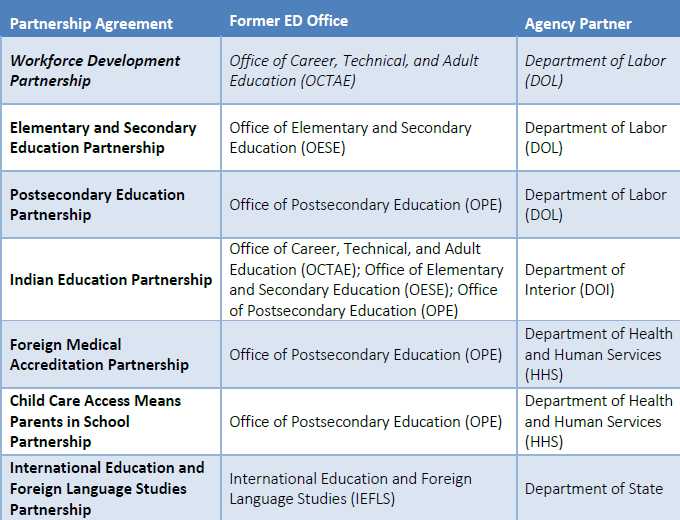
On November 18, 2025, the Department of Education (ED) announced six “interagency agreements” to shift some ED programs, activities, roles, and responsibilities to four separate federal agencies, marking the administration’s largest step yet toward its broader goal of diminishing the agency, consolidating similar programs, and eliminating what it sees as redundancies.
These agreements build upon actions from earlier in 2025, when the administration piloted this approach by shifting management of major career and technical education (CTE) and adult education programs from ED’s Office of Career, Technical, and Adult Education (OCTAE) over to the Department of Labor. Now, that pilot is becoming a broader strategy. Under these new agreements, ED maintains legal authority and oversight, but the operational work of running grant competitions, managing programs, and offering technical assistance moves to four other cognizant federal agencies.
While the interagency agreements are one of many efforts that the administration has made to hollow-out the Department of Education, it is important to remember that only Congress holds the authority to abolish, eliminate, or fully dismantle the Department. And, the necessary bipartisan support for doing so has been limited and remains unlikely, particularly in a midterm election year.
The table below summarizes the offices impacted by these agreements and the agencies with whom they will be partnering.
For more information on the interagency shifts and access to McAllister & Quinn’s strategic intelligence guides, contact us today!
Recent Developments and Congressional Pushback
On January 15th, ED announced that staff from the Office of Postsecondary Education’s Higher Education Programs division will be detailed to the Department of Labor to transition higher education grant programs onto DOL’s grants and payment systems. While ED will retain final legal authority over these programs, the operational shift has drawn sharp congressional scrutiny.
In the House-passed Labor, Health and Human Services, and Education (LHHS) funding bill, lawmakers stated that no authority exists for ED to transfer its fundamental responsibilities or congressionally appropriated funds to other agencies. The bill’s explanatory statement would require ED and its partner agencies to provide biweekly briefings to Congress on costs, staffing transfers, service delivery metrics, and grant competition safeguards.
Staying Flexible in a Shifting Policy Landscape
For institutions, the takeaway is simple: pay close attention to who is administering your funded programs, not just where the programs are located. As responsibilities shift, so will agency cultures, timelines, systems, and expectations. Staying flexible in this environment matters more than ever.
McAllister & Quinn is committed to helping colleges and universities turn strategic intelligence into action, ensuring they are prepared to meet today’s challenges and respond with agility. Our team closely monitors legislative actions, executive orders, and regulatory updates so that institutional leaders are equipped with timely insights to inform decision-making.

Micaela Quinn
Micaela Quinn is a Director of Grants and Federal Affairs in the Higher Education Practice at McAllister & Quinn. She specializes in helping small to mid-sized colleges and universities navigate the evolving federal funding landscape. Micaela partners with institutions to identify strategic grant opportunities—both federal and foundation-based—and supports them from early concept development through to full proposal submission. Her work emphasizes aligning funding strategies with institutional priorities, particularly during periods of policy and funding change.