


by: Chelsea Bolyard
Chelsea Bolyard, PhD is a Managing Director at the McAllister & Quinn Healthcare Practice. She draws on extensive experience in clinical, translational, and basic science research to guide clients in building competitive biomedical research programs and securing funding. With more than a decade of research administration expertise, she provides strategic and scientific insight supported by strong communication, project management, mentorship, stakeholder engagement, and interdisciplinary collaboration skills.

Watch our pre-recorded webinar
McAllister and Quinn’s Healthcare Practice Quick Talk: Creating your Biosketch using ScieENcv

Looking for more information?
Download our Summary of Changes to NIH Biographical Sketch Generation and Requirements memo
NIH Applications Due in 2026: Essential Guide to the New Biosketch Rules and SciENcv Mandate
If you’re preparing an NIH application due on or after January 25, 2026, you’re about to encounter some major changes to the NIH biographical sketch (biosketch) format. These updates – driven by NOT‑OD‑26‑018 – aim to harmonize NIH’s disclosure and reporting requirements with government‑wide research security standards. The biggest shift of all? SciENcv (Science Experts Network Curriculum Vitae) is now mandatory for generating and certifying your biosketch and related documents.
Whether you’re a seasoned investigator or new to NIH submissions, here’s a clear guide to what’s changing and how to update your biosketch quickly and confidently.
Why is NIH Changing the Biosketch?
In February 2024, the Office of Science and Technology released a new policy that required federal research funding agencies to align their processes for collecting common disclosure forms, such as Biosketches and Other Support. Using a single platform and common forms makes disclosures more consistent and more secure. The original timeline for implementation was delayed – but as of January 25, 2025, you finally must conform to this guidance when requesting or reporting on NIH funding.
The Big Biosketch Change Takeaways:
You MUST update your old NIH Biosketch. You will now use the Biographical Sketch Common Form plus a new NIH Biographical Sketch Supplement
Both must be created and digitally certified in SciENcv, a free online tool from the NIH used to create, manage, and certify biosketch information
Failure to use the correct forms will lead to application errors or withdrawal. By February 6, 2026, submission errors will block your application.
Step 1: If You Don’t Have It Already….Get and Link Your ORCID iD
- Visit https://ORCID.org
- Create an account and set up your profile
- Add employment, education, funding, and prior works, as appropriate
- Once your ORCID iD is active, you must link it to your eRA Commons account so it can be pulled into SciENcv. Navigation is simple: log in to eRA Commons → Personal Profile → “Create or Connect your ORCID iD.” This step is critical as it allows SciENcv uses ORCID to import your works and professional information.
Step 2: Create Your New Biosketch in SciENcv
Starting in 2026, SciENcv is the only accepted platform for generating NIH biosketches.
- Go to https://www.ncbi.nlm.nih.gov/sciencv/
- Log in using your eRA Commons credentials
- Click “+ New Document”
- Choose “NIH Biographical Sketch Common Form”
- If desired, select a data source: ORCID or eRA Commons works best for auto‑importing your information. Otherwise, “Start with a Blank Document.”
- You’ll then complete two parts:
Part 1: Biographical Sketch Common Form (NEW). This replaces several components of the old biosketch.
- Professional Preparation: Formerly “Education/Training,” now listed in reverse chronological order.
- Appointments & Positions: Include academic or professional positions from the past three years, also in reverse chronological order.
- Products: This is where citations now belong:
- Up to 5 products most closely related to the proposed project (these are analogous to the citations you previously included within your Personal Statement)
- Up to 5 other significant products that demonstrate scientific contributions (these are the ONLY citations you can directly reference within your Contributions to Science section)
- You may reference these items later in your narratives—but citations appear only here, not in the Supplement.
Part 2: NIH Biographical Sketch Supplement (NEW). The NIH will continue collecting three key narrative components, but now they live in a separate supplement attached to the Common Form.
- Personal Statement (max 3,500 characters): Similar to previous format but with updated rules:
- No citations allowed
- You may reference Products listed in the Common Form
- You can highlight relevant ongoing or recently completed research (last 3 years)
- Honors (up to 15 entries): A simple, concise list of awards or recognitions.
- Contributions to Science (up to 5 narratives, 2,000 characters each): Each should include:
- Background framing the scientific question
- Central findings
- Impact on science, health, or technology
- Your specific role
- Optional references to the Products section. Important: No citations may appear in this section.
Step 3: Certify Your Biosketch
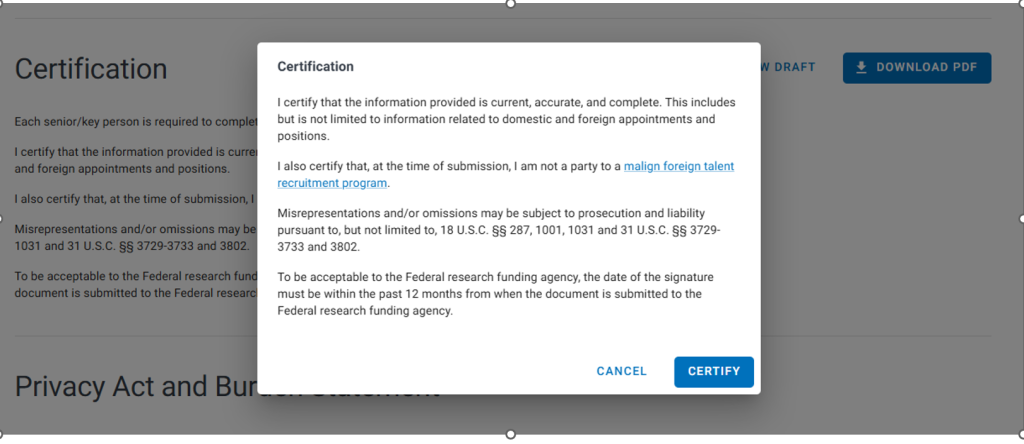
A major new compliance requirement that the investigator – and only the investigator, NOT a delegate – must certify the biosketch in SciENcv. Certification affirms that:
- All information is current and accurate
- You are not a participant in a Malign Foreign Talent Recruitment Program (MFTRP)
- You have completed required research security training